Recovery
Sauna after a workout.
A quiet ten minutes of heat can be a good end to training, as long as you go about it sensibly.

In short
Is it good to use a sauna after a workout?
For most healthy adults, a sauna after a workout is safe, and many people find it relaxing. Wait until your breathing has settled, drink water first, and stay in for ten to fifteen minutes in a traditional sauna. Skip it if you feel dizzy, unwell or dehydrated, and check with a doctor if pregnant.
What does a sauna actually do after a workout?
A sauna heats you from the outside. Your skin warms, you sweat freely, your heart beats faster and the blood vessels near the skin widen to shed heat. For many people, the result after training is a feeling of warmth and calm, looser muscles and a quieter mind. That relaxation is the main reason people enjoy a sauna after a workout, and it is reason enough.
Scientists are still exploring the longer-term effects of regular sauna use, and the picture is developing. It is also worth knowing what a sauna does not do: it does not melt fat, the weight you lose in it is water you need to drink back, and sweating is not a cleanse. Treat it as a pleasant way to wind down.
How long should you stay in a sauna?
For a traditional sauna, which usually runs at about 80 to 95°C, ten to fifteen minutes is typical for healthy adults. If you are new to it, start with five to eight minutes and build up over a few visits. Some people prefer two shorter rounds with a cool shower and a rest in between, rather than one long one.
Knowing how long to stay in a sauna is about listening to your body as much as watching the clock. Leave straight away if you feel dizzy, light-headed or sick, or if your heart is racing uncomfortably. There is no prize for the longest stay.
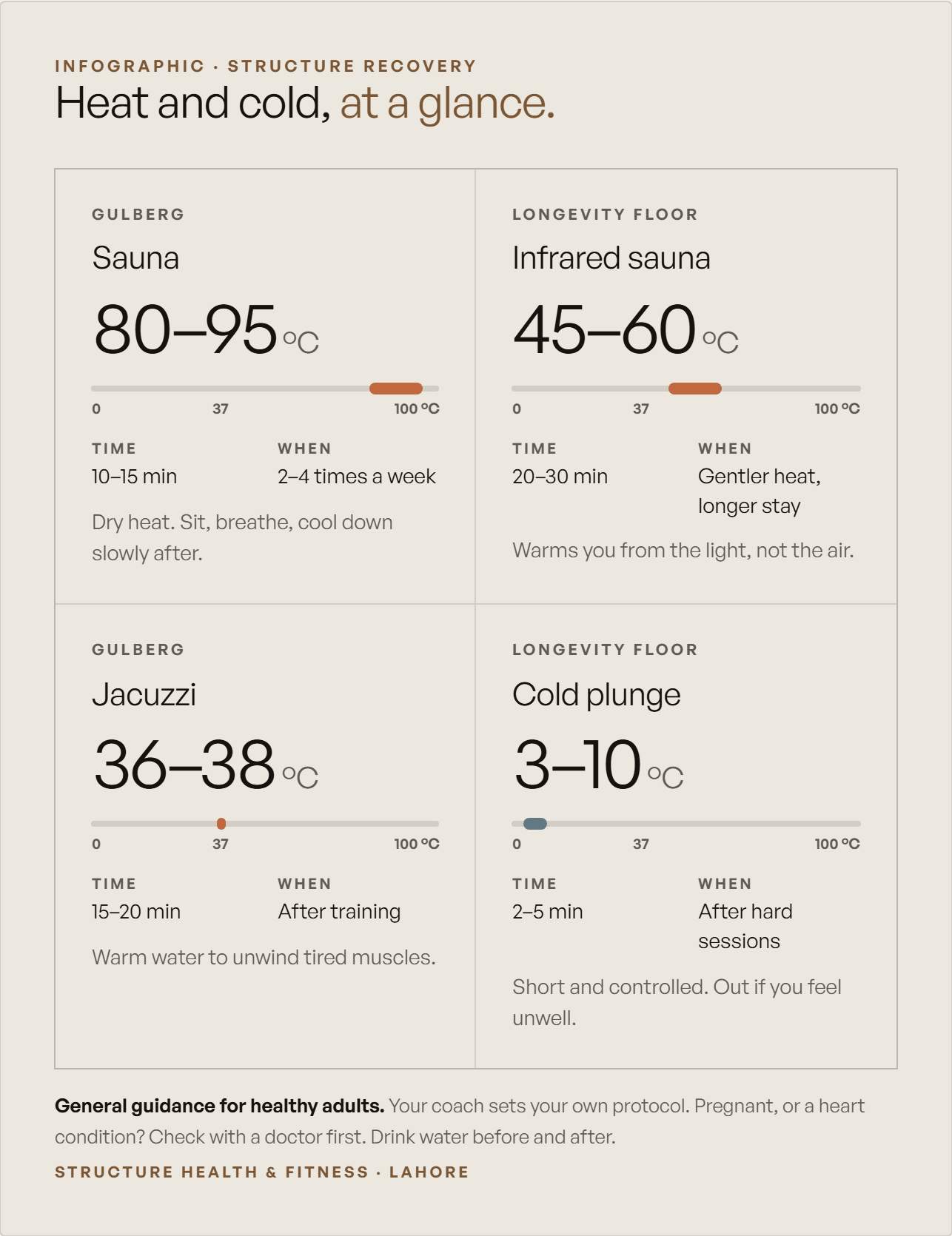
Infographic · Structure recovery
Heat and cold, at a glance.
Gulberg
Sauna
80–95°C
- Time
- 10–15 min
- When
- 2–4 times a week
Dry heat. Sit, breathe, cool down slowly after.
Longevity Floor
Infrared sauna
45–60°C
- Time
- 20–30 min
- When
- Gentler heat, longer stay
Warms you from the light, not the air.
Gulberg
Jacuzzi
36–38°C
- Time
- 15–20 min
- When
- After training
Warm water to unwind tired muscles.
Longevity Floor
Cold plunge
3–10°C
- Time
- 2–5 min
- When
- After hard sessions
Short and controlled. Out if you feel unwell.
General guidance for healthy adults. Your coach sets your own protocol. Pregnant, or a heart condition? Check with a doctor first. Drink water before and after. Structure Health & Fitness · Lahore
These are typical figures, and you do not have to reach them. Your coach sets your own protocol, and shorter is always fine.
Nobody is timing you in the sauna. Leave while it still feels good.
How soon after a workout should you use the sauna?
Give yourself a few minutes first. Walk around, let your breathing and heart rate come down, and drink a glass of water. Going straight from a hard set into the heat stacks one strain on top of another, and that is when people are most likely to feel faint. After a long or very sweaty session, especially in the Lahore summer, have a proper drink and wait a little longer.
How often can you use a sauna?
Two to four times a week suits most people who train regularly, and there is no need to go after every session. Whether you use a sauna in Lahore’s short winter or after a sweaty session in June, many people save it for the end of their hardest days, or the end of the week, when winding down matters most.
Keep it for after training rather than before. Heat beforehand can leave you feeling flat and a little drained, which is the opposite of what you want before a heavy lifting day or a hard conditioning session.
What is the difference between a sauna and an infrared sauna?
A traditional sauna heats the air around you, so it feels intensely hot. An infrared sauna uses panels that warm your body more directly, so the air is much cooler, usually around 45 to 60°C, and sessions are longer, about twenty to thirty minutes. Many people who find a traditional sauna overwhelming are comfortable in an infrared one. At Structure, the infrared sauna is part of the Longevity Floor, alongside its other recovery tools.
Sauna or jacuzzi after training?
They feel quite different. A jacuzzi is warm water, around 36 to 38°C, with jets moving around you, and fifteen to twenty minutes is typical. It is gentler than a sauna, and many people find it eases the feeling of tight muscles and helps them unwind. Some like a short sauna followed by a calm soak; others prefer one or the other. Neither is required, so choose the one you enjoy.
If you are looking for a sauna and jacuzzi in Lahore, the Gulberg club has a sauna and jacuzzi as well as its temperature-controlled pool, included on the Standard and Premium plans. The membership plans and add-ons show what each one includes.
Who should not use a sauna?
Heat puts real demands on the heart and circulation, so a sauna is not for everyone. Check with your doctor first, or simply skip it, if any of these apply:
- You are pregnant.
- You have a heart condition, high or low blood pressure, or take medication that affects either.
- You feel unwell, feverish or dehydrated.
- You have been drinking alcohol.
- You have a condition that affects how you handle heat, or you have fainted in the heat before.
Older adults should take extra care, and children should not use a sauna without medical advice. When in doubt, ask your doctor and tell your coach.
What about a cold plunge after the sauna?
Moving between hot and cold is popular, and the cold side has its own guidance. Our cold plunge guide covers it. For everything else that helps you recover between sessions, from sleep to easy walks, see recovery habits for training.
How do you make a sauna part of your routine?
Keep it simple: train, cool down, drink water, then ten minutes of heat on the days you have time. Shower afterwards, drink again, and give yourself a few minutes before heading back out into the traffic. If you would like a coach to look at your training and recovery at Structure together, book a free first visit at any club. You leave with a starting plan, whether or not you join.